


130 years of Ukrainian football: recalling the most memorable moments in history
Since the historic date of 1894, Ukrainian society has experienced much—two world wars, the collapse of empires (Russian and Austro-Hungarian), the creation and dissolution of the USSR, military aggression from the RF, the annexation of Crimea and the occupation of Donbas, open large-scale invasion.

Since the historically significant date of 1894, Ukrainian society has experienced much — two world wars, the collapse of empires (Russian and Austro-Hungarian), the creation and dissolution of the USSR, military aggression from Russia, the annexation of Crimea and occupation of Donbas, open large-scale invasion.
Along with society, Ukrainian football has also endured these trials — at certain stages of its biography, it was part of other countries' football scenes until the period of gaining independence. Clearly — there were highs and lows.
Lviv, Odessa, Chernivtsi, Kyiv, Kharkiv, Yuzivka (now Donetsk), Katerynoslav (now Dnipro), Mykolaiv, Sevastopol, Uzhhorod — these and other Ukrainian cities became centers for the birth and development of football, gifted renowned players, teams, and traditions. Almost a hundred years ago, our football teams won titles as the strongest in the Russian Empire (Odessa — 1912), Poland (Lviv "Pogoń" — 1922, 1923, 1925, 1926), USSR (Kharkiv "Storm" — 1924), and Slovakia (Uzhhorod "Rus" — 1933, 1936).

Recovering from the horrors of World War II, Ukrainian football gradually returned to the highest level. Kyiv's "Dynamo" won the USSR Cup in 1954 and first claimed the Soviet Championship title in 1961. The same year, Donetsk's "Shakhtar" first won the USSR Cup, repeating their achievement in 1962.
In the mid-1960s, Kyiv's "Dynamo" firmly established itself among the giants of Soviet football. Before Ukraine gained independence, Kyivans had won the Soviet Championship title 13 times (an unbeaten record) — in 1961, 1966, 1967, 1968, 1971, 1974, 1975, 1977, 1980, 1981, 1985, 1986, and 1990 — and the USSR Cup nine times (the second-best record in tournament history) — in 1954, 1964, 1966, 1974, 1978, 1982, 1985, 1987, and 1990.
The title of the strongest team in the Soviet Union was also won by Luhansk "Zarya" (1972) and Dnipro (1983, 1988), while Shakhtar (1961, 1962, 1980, 1983), Lviv's "Karpaty" (1969), Kharkiv's "Metalist" (1988) and Dnipro (1989) won the USSR Cup.
Ukrainian clubs repeatedly made it into the top three finishers: 14 times — Dynamo, four times — Dnipro and Shakhtar, once — Odesa's "Chornomorets". In total, 15 of our clubs played in the elite division of the Soviet Championship. In some seasons, more than a third of the participants in the top league were from Ukraine.
Kyiv's Dynamo under Valeriy Lobanovskyi became the first Ukrainian team to win an international title when they won the European Cup Winners' Cup in 1975. Kyiv's Dynamo also won the UEFA Cup twice, in 1986 and 1992.
In 1986, Valeriy Lobanovskyi led Dynamo to a historic victory over Steaua București in the European Cup Winners' Cup final. This was followed by two UEFA Cup titles for Dynamo Kyiv under Lobanovskyi's leadership.

The best goalkeepers of the USSR were recognized as: Viktor Bannikov (1964, Dynamo), Yevgeny Rudakov (1969, 1971, 1972, Dynamo), Yuri Degtyarev (1977, Shakhtar), and Viktor Chanov (1986, Dynamo). Also — natives of Ukraine who at that time represented Moscow clubs: Vladimir Maslachenko (1961), Viktor Bannikov (1970), Vladimir Pilguy (1973) and Vyacheslav Chanov (1981).
Ukrainian football schools and Ukrainian club representatives had a constant presence in the Soviet national team.
In 1960, Vladimir Maslachenko, Yuri Kovalev, and Yuri Voynov became European champions. In 1972, under the leadership of Donetsk native Oleksandr Ponomaryov, Evgeny Rudakov, Vladimir Troshkin, Viktor Kolotov, Anatoly Konkov, Vladimir Onishchenko, Edward Kozynkevych, Vladimir Kaplichnyi, Viktor Matviienko, Mikhail Fomenko, Viktor Bannikov and others became European vice-champions.
In 1988, under the leadership of Valeriy Lobanovskyi, Viktor Chanov, Vladimir Bessonov, Oleg Kuznetsov, Anatoly Demianenko, Vasyl Rats, Serhiy Baltacha, Gennadiy Litovchenko, Oleksiy Mykhaylichenko, Oleksandr Zavarov, Oleg Protasov, Igor Belanov, Ivan Vishnevskyi and Viktor Pasulko became European vice-champions.
Viktor Serdyukov, Leonid Ostrovskii, Josef Sabo, Valeriy Porkuian, and Viktor Bannikov were among the top four at the 1966 World Cup in the Soviet national team lineup.
The Soviet national team won gold at the Melbourne-1956 Olympics with the help of Josef Beča (and during qualification — also Ivan Mozher). To Seoul-1988, under Kyiv native Anatoly Beshovets' leadership, Oleksiy Mykhaylichenko, Vladimir Lutyi, Vadim Tischenko, Volodymyr Tatarchuk, Yevhen Yardynenko and Oleksii Cherendyk joined.
Third place at the 1972 Munich Games was won by Oleg Blokhin, Yuri Istomin, Vladimir Kaplichnyi, Viktor Kolotov, Evgeny Rudakov, Vyacheslav Semenov, Josef Sabo, Yuri Yeliseev, Vladimir Onishchenko, Anatoly Kuksov and Vladimir Pilguy (coaches — Oleksandr Ponomaryov).
Third place at the 1976 Montreal Games was won by Anatoliy Konkov, Viktor Matviienko, Mikhail Fomenko, Stefan Reshko, Volodymyr Troshkin, Vladimir Onishchenko, Viktor Kolotov, Vladimir Veremeyev, Oleg Blokhin, Leonid Buria and Viktor Zyaginets (coaches — Valeriy Lobanovskyi and Oleksandr Bazilevych).
And third place at the 1980 Moscow Games was won by Vladimir Pilguy, Serhiy Baltacha, Serhiy Shavlo, Volodymyr Bessonov and Serhiy Andriev.
Also, in total, three (!) representatives of Ukraine — Oleg Blokhin (№ 1 — 112 matches), Anatoliy Demianenko (№ 4 — 80) and Volodymyr Bessonov (№ 5 — 79) — are among the top five regulars in the Soviet national team. Also, three of ours are among the top five scorers for the Soviet national team: Oleg Blokhin (№ 1 — 42 goals), Oleg Protasov (№ 2 — 28) and Viktor Kolotov (№ 5 — 22).
And how many Ukrainians have won medals of various calibers in European and World Championships as part of the Soviet youth and junior national teams is hard to count.
It should also be noted that representatives of Ukraine were among the best football referees in the USSR — Konstantin Demchenko (Zhytomyr), Matvii Pinskyi (Kharkiv), Mykola Balakin (Kyiv), Oleksandr Malec' (Uzhhorod), Oleksandr Mugurdumov (Kyiv), Mykola Kirsanov (Kyiv), Oleksandr Tsapovecki (Kyiv), Yaroslav Balkin (Dnipro), Yuriy Sergiyenko (Kharkiv), Mykhailo Kusen (Lviv), Konstantin Vihrov (Kyiv), Mirosław Stupar (Ivano-Frankivsk), Oleksandr Temetiev (Uzhhorod), Petro Kobychyk (Chernivtsi) and Volodymyr Pyanykh (Donetsk).
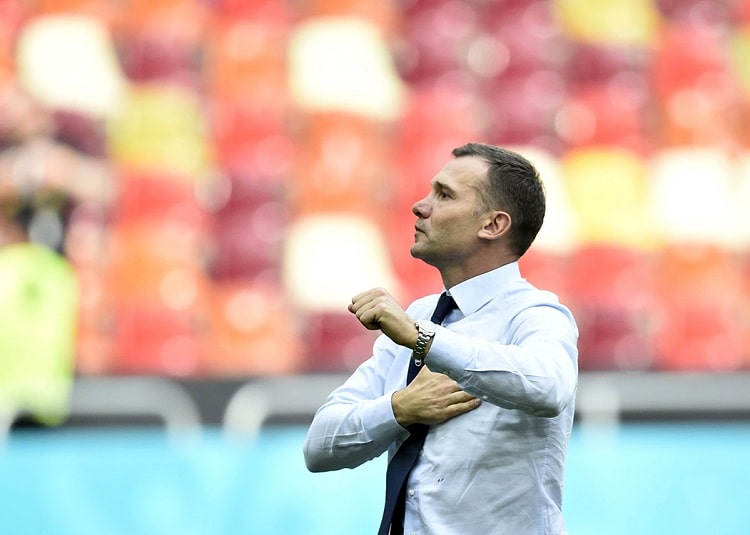
Ukrainian football continues to receive its share of recognition on the international stage after 1991. The national team of Ukraine participated in the World Cup-2006 (quarterfinals, coach — Oleg Blokhin), Euro-2012 (group stage, Oleksiy Mykhaylichenko), Euro-2016 (group stage, Mikhail Fomenko), Euro-2020 (quarterfinals, Andriy Shevchenko) and Euro-2024 (group stage, Serhiy Rebrov).
The Ukrainian U-17 team has already participated in the final tournament of the European Championship 11 times but has yet to improve upon its debut performance at Euro-1994 — third place under Vladimir Kiyanchenko's leadership.
This year (July 15), the Ukrainian U-19 team under Dmitro Mykhaylenko will participate in the final tournament of the European Championship for the eighth time. The best benchmarks for our boys — gold in 2009 (coach — Yuriy Kalitvinsev), silver in 2000 (Anatoliy Krushenko), reaching the top four in 2004 (Pavlo Yakovenko) and 2018 (Oleksandr Petrakov).
The Ukrainian U-20 team has participated in four World Cups: three times it reached the round of 16 (2001 — coach Anatoliy Krushenko, 2005 — Oleksiy Mykhaylichenko, 2015 — Oleksandr Petrakov), and on its fourth attempt (2019 — Oleksandr Petrakov) won the title of world champion!


