
The "Open Football Festival" took place in Kyiv

The UEFA Executive Committee, which includes Andriy Pavelko, president of the UAF, has approved a new format for women's national league matches and qualifying tournaments for European and World Championships in line with UEFA's Women's Football Development Strategy Time For Action aimed at reforming the competitions. This is reported on the official organization website.

Photo from uefa.com
The UEFA Executive Committee, which includes Andriy Pavelko, president of the Ukrainian Football Association (UAF), has approved a new format for women's national league and qualification tournaments for European and World Championships in line with UEFA’s Women’s Football Development Strategy Time For Action. This is reported on the organization's official website.
The reforms were carried out according to recommendations from the UEFA Women's Football Committee and based on the findings of a working group on national team competitions, which included representatives from various national associations.
The Format
For the first time, this new format will be applied in the qualification for Euro 2025, which will start in autumn 2023. The same principles will apply to the World Cup qualifiers in 2027.
The format combines UEFA Nations League with European Championship qualifications. It includes a promotion and relegation system (with upward and downward movement) as well as a final tournament for the Nations League.
Based on group stage results, knockout matches will be held. The new format divides national associations into three levels. At each level, teams are divided into groups of four (or three), where they play two home and away matches against each opponent.
Nations League
After the Nations League concludes, a tournament winner will be determined, as well as, every four years, three European teams that qualify for the Olympics. The final ranking of the Nations League (with automatic promotion and relegation), along with knockout matches, determines the starting position of national teams in the European Championship qualification.
European Qualification
After the conclusion of the European Championship qualifiers, a final ranking will be compiled to determine which teams qualify directly for Euro and who participates in the knockout tournaments for European qualification. This ranking with its automatic promotion and relegation system also determines in which divisions national teams start their next qualifying cycle.
How the New Format Will Work
An example is illustrated based on participation of 51 national teams. The Ukrainian team, currently in the Premier League Nations League, will play in Division B.
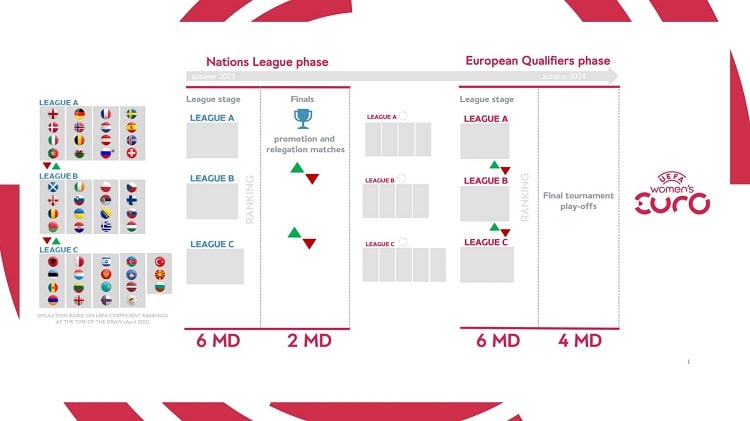
Photo uefa.com
Nations League Phase
The Nations League starts in autumn 2023 and consists of a group stage, promotion/relegation matches, and a final round with two semi-finals, a third-place match, and a final.
Teams will be divided into three leagues based on their current UEFA women's national team rankings.
Leagues A and B each consist of 16 teams split into four groups of four. League C includes 19 teams, divided into four groups of four and one group of three (the actual composition of the groups in League C will depend on the number of participating teams).
All matches take place over six matchdays, with each team playing one home and one away game against all other teams in their group. The ultimate goal of this stage is to win the Nations League and secure a better starting position for the next tournament.
Every four years, the final of the Nations League will also serve as European qualification for the women's Olympic football tournament. This will first apply for the 2024 Olympics in France.
Positions in the Nations League at the end of the group stage determine who advances to the final and what starting positions teams have in the European qualification phase. Depending on their ranking after six matches, teams either retain their position in the league, automatically promote or demote, or participate in knockout matches for promotion/relegation.
Nations League Final
The four group winners of League A advance to the Nations League final. The final matches, which take place on a home-and-away basis, consist of semi-finals, a third-place match, and a final. One of the participating teams organizes these finals. In 2024, two finalists join France as European representatives in the women's Olympic football tournament (along with the team that finishes third if France reaches the final).

Photo uefa.com
Automatic Promotion/Relegation
For upcoming European qualifications:
1) winners and runners-up of League A groups remain in League A;
2) winners of Leagues B and C will be promoted to the next league;
3) all teams finishing fourth in Leagues A and B, as well as the team that finishes worst third in League B, will be relegated to the next lower league;
4) two teams finishing second and all teams finishing third and fourth in League C remain in League C.

Photo uefa.com
Knockout Matches for Promotion/Relegation
All remaining teams participate in promotion/relegation matches, which take place home and away, giving them another chance to compete for a better starting position in the European qualifications:
1) third-placed teams from League A play against second-placed teams from League B. Winners stay in League A; losers move down to League B;
2) three best third-placed teams from League B compete against the top three second-placed teams from League C. Winners remain in League B; losers drop to League C.
These matches take place simultaneously with the Nations League final.
European Qualification Phase
The European qualification phase will begin in spring 2024 after the conclusion of the Nations League and will consist of a group stage and a playoff round. The group stage of the European qualification follows the same format as the Nations League, with teams divided into three leagues: League A with 16 teams, Leagues B and C each with 16 and 19 teams respectively.
The starting position for each team in the league is determined based on results from the Nations League as described above. Again, teams compete in groups of four or three (League C) over six matchdays. Each national team plays one home and one away game against all other teams in their group. The ultimate goal of this stage is to qualify for the women's European Championship.

Photo uefa.com
Eight best teams in League A will qualify for Euro 2025. If the host country of the final tournament does not qualify, it is still guaranteed a place. In case there are multiple hosts, this guarantee applies to up to two countries.
Remaining spots will be contested in two rounds of playoffs. In the first round, third and fourth-placed teams from League A play against group winners and three best second-placed teams from League C. Eight winners advance to the second round.
Four group winners and two best second-placed teams from League B will face off with remaining second-placed teams and four third-placed teams in League B. Six winners move on to the second round.
In the second round, 14 teams compete for seven spots at Euro 2025 final tournament.
Qualification from Europe to the World Cup 2027 will follow a similar format with adjustments made to the playoff system due to fewer final licenses.
Read also


